The Five Koshas: Understanding the Layers of Your Being
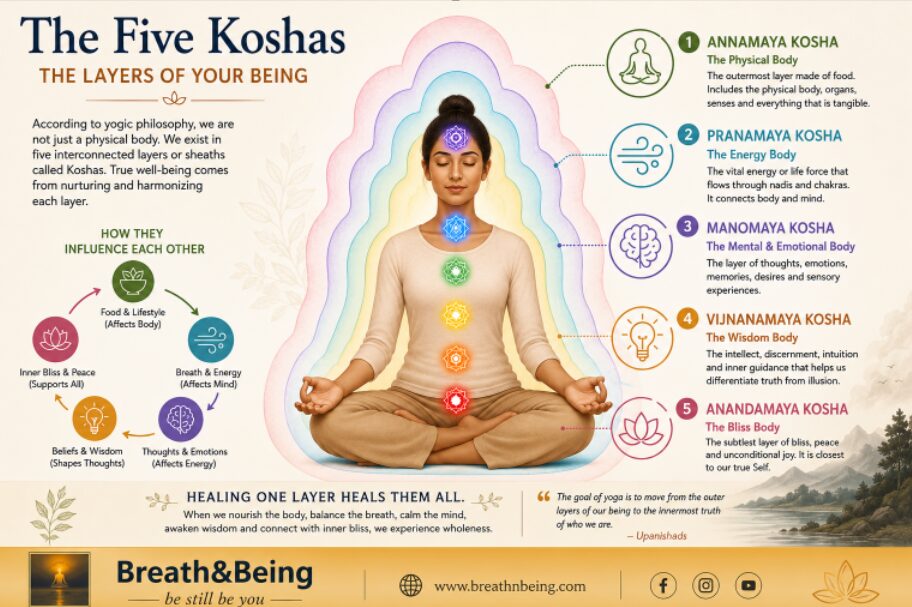
Ancient yogic philosophy views the human being as far more than just a physical body. According to the wisdom of the Taittiriya Upanishad, our existence consists of five interconnected layers or “sheaths” known as the Pancha Koshas (Pancha meaning five and Kosha meaning sheath, covering, or layer).
Imagine a bright lamp covered by five translucent cloths. The light still shines, but each layer makes it appear dimmer. Similarly, our true nature—the eternal Self or Atman—is covered by five layers that shape our physical experiences, emotions, thoughts, intuition, and ultimately our connection with pure consciousness.
The purpose of yoga is not merely to strengthen the body or calm the mind. Its ultimate goal is to gradually purify and transcend these five koshas, allowing us to realize our true Self.
Understanding the koshas provides a practical roadmap for holistic health and self-discovery. Every aspect of our life—our food, breath, thoughts, relationships, and meditation—affects one or more of these layers.
What Are the Five Koshas?
The five koshas are:
- Annamaya Kosha – The Physical Body (Outermost)
- Pranamaya Kosha – The Energy Body
- Manomaya Kosha – The Mental and Emotional Body
- Vijnanamaya Kosha – The Wisdom Body
- Anandamaya Kosha – The Bliss Body (Innermost)
Each kosha is subtler than the previous one. They are not separate entities but interwoven dimensions of our existence, constantly influencing one another.
Let’s get a basic overview of each Kosha and understand why it is important to maintain balance between them.
1. Annamaya Kosha – The Physical Body
Anna means food.
The Annamaya Kosha is the outermost layer and represents the physical body made from the food we consume. Every cell, muscle, bone, organ, and tissue is sustained by nourishment obtained from the earth.
This body is born, grows, ages, and eventually returns to nature. Although we often identify ourselves with this physical form, yogic philosophy teaches that it is only the outermost expression of who we truly are.
This Kosha is Characterised in the body by Bones and muscles, Organs and tissues, Skin and sensory organs, Physical health, Movement and posture. It thrives through Fresh, wholesome food, Regular body movement, Yoga asanas, Adequate sleep, Proper hydration, Exposure to sunlight, Rest and recovery
Signs of Imbalance
When the physical sheath is disturbed, one may experience physical issues or imbalances which can be subtle or strong signs of a potential disease. Some of these can be Chronic fatigue, Poor digestion, Body pain, Weak immunity, Hormonal imbalance , Low vitality etc.
Recommended Practices to keep the Annamaya Kosha in Balance include –
- Yoga
- Balanced nutrition
- Physical exercise
- Proper sleep
- Walking in nature
- Mindful eating
2. Pranamaya Kosha – The Energy Body
Prana means life force or vital energy.
If the physical body is like a light bulb, prana is the electricity that makes it glow.
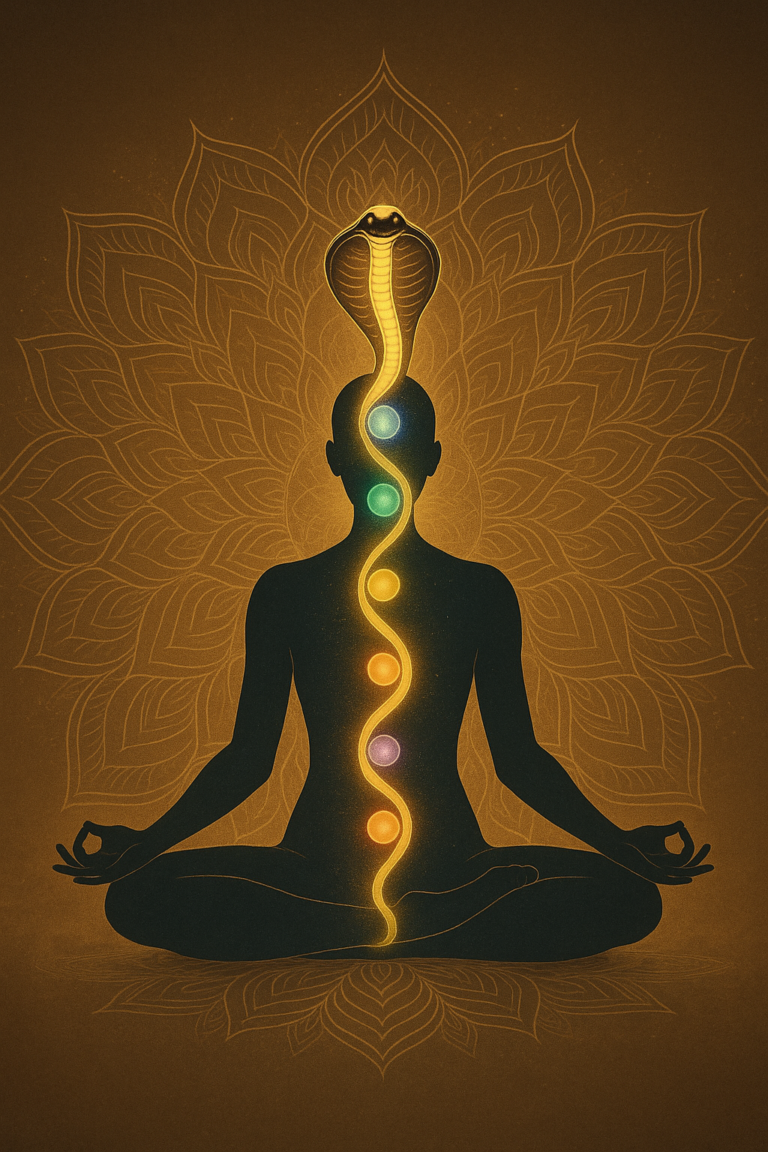
Pranamaya Kosha is the subtle energy system that animates the physical body. It includes the flow of prana through nadis (energy channels) and chakras (energy centers). According to yogic texts, breath is the primary vehicle through which prana is absorbed and distributed throughout the body.
This explains why even before thoughts arise, our breathing changes according to our emotional state. The Breath, Prana (life Force), Nadis, Chakra, all these are the Components of Pranamaya Kosha
If we go further, the prana or energy is classified into five major Pranas with different functions and area of working. These are – Prana, Apana, Samana, Udana, Vyana
Signs of Healthy Prana include – High energy for most parts of the day, Enthusiasm, Quick recovery, Emotional resilience and Mental alertness.
Signs of Blocked Prana include – Feeling lethargic most of the time, Frequent Fatigue, Anxiety , Brain fog , Restlessness , Low motivation, Shallow breathing and Slow recovery from diseases.
Recommended Practices to keep the Pranamaya Kosha in Balance include –
- Pranayama
- Breath awareness
- Nature walks
- Grounding
- Energy balancing practices
- Proper posture
One of the most profound yogic principles states:
“Breath is the bridge between the body and the mind.”
3. Manomaya Kosha – The Mental and Emotional Body
This kosha constitutes Thoughts, Emotions, Memories, Beliefs, Imagination, Sensory processing. It is in this Kosha where we experience joy, sadness, fear, excitement, anger, jealousy, attachment, and countless other emotional states.
The Manomaya Kosha constantly receives information from our senses and interprets it based on past experiences. For many people, this sheath dominates daily life. Some of the themes associated with this Kosha are Internal dialogue, Emotional reactions , Likes and dislikes , Habits, Fears and Desires.
Modern Challenges
In the modern era our mental sheath is continuously challenged by Social media, News, Notifications, Overthinking, Comparison, Information overload. As a result, many people feel mentally exhausted despite being physically healthy.
Signs of Imbalance- Any form of Anxiety, Stress, Emotional instability, Negative thinking patterns, Irritability, Insomnia, Worry etc can be considered as imbalances in the Manomaya Kosha.
Recommended Practices to keep the Pranamaya Kosha in Balance include :
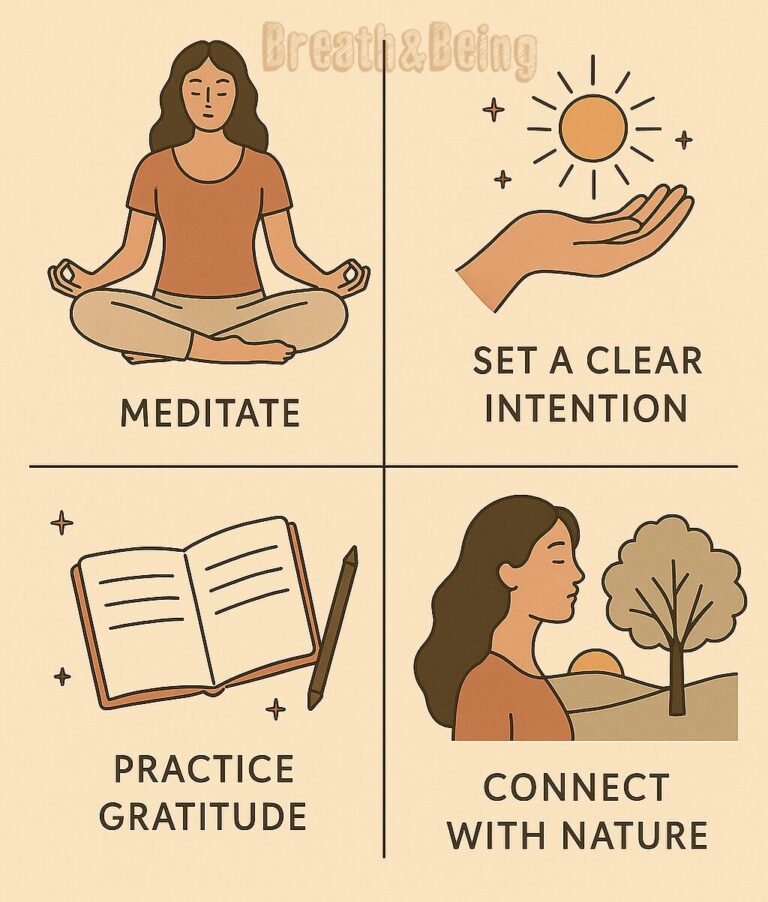
- Meditation
- Mindfulness
- Mantra chanting
- Journaling
- Positive affirmations
- Limiting sensory overload (limited use of digital gadgets)
- Practicing gratitude
The quality of our thoughts gradually shapes the quality of our lives.
4. Vijnanamaya Kosha – The Wisdom Body
Vijnana means higher knowledge or intuitive wisdom.
This sheath represents the faculty of discernment (Viveka), intuition, ethical understanding, and deep inner knowing. Unlike the Manomaya Kosha, which constantly reacts, the Vijnanamaya Kosha observes.
It is the inner witness that can distinguish:
- Truth from illusion
- Wisdom from impulse
- Long-term well-being from short-term pleasure
When this kosha is awakened, decisions become clearer and less influenced by emotional turbulence.
This Kosha is Characterised by Intuition, Self-awareness, Wisdom, Discernment, Inner guidance and Ethical values.
Signs of a Strong Wisdom Sheath – If someone has greatEmotional maturity, Inner stability , Compassion, along with Better decision-making, Self-control and Clarity of purpose, then person can be said to possess Strong Vijnanamaya Kosha. The disciplined Yogis and Monks are great examples for this.
This Kosha can be balanced using Practices like –
- Self-Awareness
- Study of sacred texts (Vedas , Upanishads etc)
- Contemplation
- Meditation
- Practicing Silence
- Reflective journaling
A strong Vijnanamaya sheath can help us answer deeper questions of life such as – Who am I? Why am I here? What truly matters? etc.
5. Anandamaya Kosha – The Bliss Body
Ananda means bliss. The Anandamaya Kosha is the subtlest sheath and is closest to the Atman. It is not excitement or pleasure but a profound state of peace that exists independent of external circumstances.
Many people briefly experience this layer during acts like Deep meditation, Moments in nature, Selfless service , Prayer , Deep love , Creative flow state , Dreamless sleep.
These glimpses remind us that joy is not something we acquire; it is an inherent quality of our being.
Inner peace, Contentment, Love , Unity, Compassion, Presence, Serenity are some of the characteristics that represent this Sheath.
Although this kosha is called the bliss body, it is still a sheath. Yogic philosophy teaches that even bliss is an experience. Beyond all experiences lies the Atman, the pure, unchanging consciousness that is our true nature. Thus, the Anandamaya Kosha is the final veil before Self-realization.
The Interconnected Nature of the Five Koshas
One of the most profound insights of yogic philosophy is that the five koshas do not function independently. They are deeply interconnected, like layers of a single living organism. A change in one sheath creates a ripple effect through all the others. Just as a pebble dropped into a still pond creates expanding circles, an imbalance in one kosha gradually influences the rest.
Modern science increasingly supports this holistic understanding. We now know that our physical health affects our mental well-being, our thoughts influence our physiology, our breathing regulates the nervous system, and our emotional state can impact immunity, digestion, and even hormonal balance. Thousands of years ago, yogic sages described this intricate relationship through the concept of the Pancha Koshas.
From the Physical Body to the Mind
Consider the effect of poor nutrition. If we consistently consume highly processed foods, eat irregularly, or deprive our body of essential nutrients, the first layer affected is the Annamaya Kosha, the physical body. Digestion becomes sluggish, energy levels decline, inflammation may increase, and sleep quality often deteriorates.
However, the effects do not stop there. Because the physical body has less vitality, the Pranamaya Kosha—the energy body—also suffers. Prana does not circulate efficiently, leaving us feeling fatigued, heavy, and unmotivated.
As energy decreases, the Manomaya Kosha, the mental and emotional body, is affected. We may become irritable, impatient, anxious, or emotionally reactive. Tasks that once felt easy begin to seem overwhelming, not because our circumstances have changed, but because our energy reserves have diminished.
When the mind becomes clouded, the Vijnanamaya Kosha, the wisdom sheath, struggles to function clearly. Decision-making becomes impulsive, concentration weakens, and it becomes harder to distinguish temporary desires from genuine needs.
Eventually, this chain of imbalance distances us from the deep peace of the Anandamaya Kosha, making inner contentment feel elusive.
What began as a seemingly simple issue of poor diet gradually influenced every dimension of our being.
The Journey Through the Koshas
Yogic practice gradually guides us inward. In the yogic practices we are actually trying to balance each Kosha, maintaining a strong harmony with the interconnected of the 5 Koshas.
The journey often unfolds in the following flow :
Physical Awareness → Energy Awareness → Mental Awareness → Wisdom → Bliss → Self-Realization
Each layer becomes progressively quieter and subtler, leading us toward our essential nature. This inward movement is sometimes compared to peeling the layers of an onion. As each sheath becomes purified, we move closer to the radiant center of our being.
The Ultimate Goal: Beyond the Koshas
The koshas are invaluable tools for understanding ourselves, but yogic philosophy reminds us that they are not our final identity. We are not merely the body. We are not merely our breath. We are not our thoughts. We are not even our moments of bliss.
Beyond all five sheaths shines the Atman—pure awareness, untouched by birth, change, suffering, or death. The practices of yoga, meditation, pranayama, ethical living, and self-inquiry are not ends in themselves. They are pathways that gradually remove the coverings obscuring this inner reality.
As these layers become purified, we begin to experience life with greater clarity, compassion, resilience, and peace. The realization dawns that the wholeness we have been seeking has always existed within us.