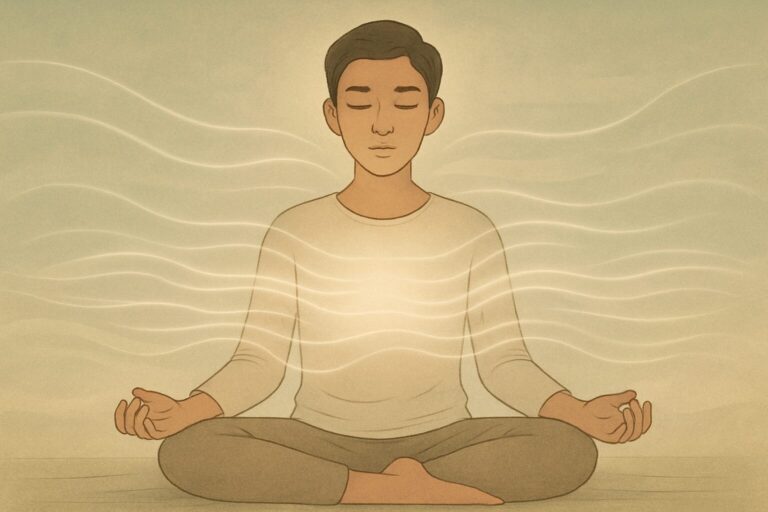
Anulom Vilom Pranayama: Balancing Body, Mind, and Energy
Long before modern science began exploring the connection between breathing and the nervous system, the ancient yogis of India had already discovered a profound truth: the quality of your breath determines the quality of your mind.
Observe your breath during moments of anger, anxiety, excitement, or deep peace, and you will notice that it changes almost instantly. A restless mind produces an irregular breath, while a calm mind breathes slowly and effortlessly. Yoga teaches that this relationship works both ways. Just as the mind influences the breath, the breath also has the power to influence the mind.
This understanding gave birth to the science of Pranayama—the conscious regulation and expansion of life force through the breath.
Among the many pranayama techniques described in yogic literature, Anulom Vilom holds a special place as it is often the first breathing practice introduced to beginners because of its simplicity. This pranayama practice is so versatile that even the most advanced yogis continue to practice it throughout their lives.
According to the yogic tradition, Anulom Vilom gradually restores harmony between the body’s subtle energies, creating the ideal foundation for meditation and inner transformation.
In today’s fast-paced world, where our attention is constantly pulled in different directions, this ancient practice has become more relevant than ever. Whether your goal is to reduce anxiety, improve concentration, sleep better, or deepen your spiritual practice, Anulom Vilom offers a gentle yet remarkably effective path toward balance.
But to truly appreciate its power, we must first understand what this practice really means.
What is Anulom Vilom?
The term Anulom Vilom comes from two Sanskrit words that beautifully describe the essence of the practice.
Anulom means with the natural order, while Vilom means against or in the reverse order. Together, they refer to the alternate movement of the breath through the left and right nostrils in a rhythmic and balanced manner.
Many people casually refer to Anulom Vilom as alternate nostril breathing, but this translation captures only the physical action. From yogic point of view, the practice is not merely about changing the path of the breath; it is about balancing two complementary forces that influence every aspect of our physical, mental, and emotional life.
This is why experienced practitioners often describe Anulom Vilom not as a breathing exercise but as a practice of inner equilibrium.
Anulom Vilom and Nadi Shodhana: Are They the Same?
One of the most common sources of confusion is the relationship between Anulom Vilom and Nadi Shodhana.
Today, many yoga teachers use the two names interchangeably, and in everyday practice this is perfectly acceptable. However, traditional yogic texts make a subtle distinction.
Nadi Shodhana literally means purification of the energy channels. Classical descriptions often include specific breathing ratios, breath retention (kumbhaka), and a gradual progression under the guidance of an experienced teacher. Its purpose is the systematic purification of the nadis so that prana can flow freely through the subtle body.
Anulom Vilom, on the other hand, usually refers to the simpler practice of alternating the breath between the nostrils without breath retention. It is easier to learn, safe for most people, and serves as an ideal introduction to pranayama.
In many modern yoga schools, Anulom Vilom is considered the first stage of Nadi Shodhana. Once the breath becomes smooth, relaxed, and effortless, practitioners gradually progress toward the more traditional methods.
Regardless of the terminology, both practices share the same underlying objective—to restore harmony within the human energy system.
The Yogic Science Behind Anulom Vilom
To understand why alternate nostril breathing is so highly valued, we must look beyond the physical body.
According to yogic philosophy, the human being is composed of multiple layers of existence. Beneath the physical body lies a subtle energetic body through which prana, the vital life force, continuously flows. This movement of prana takes place through thousands of subtle channels known as nadis.
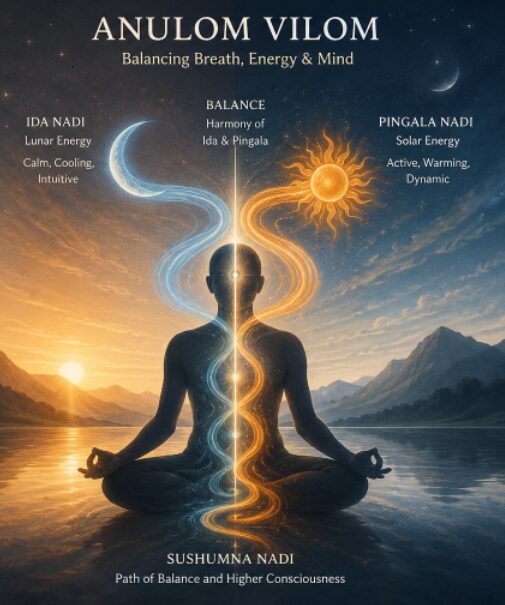
Ancient yogic texts describe approximately 72,000 nadis, though this number is symbolic rather than anatomical. Among these countless pathways, three are regarded as the most significant: Ida, Pingala, and Sushumna.
According to yogic philosophy, the human being is composed of multiple layers of existence. Beneath the physical body lies a subtle energetic body through which prana, the vital life force, continuously flows. This movement of prana takes place through thousands of subtle channels known as nadis.
Ancient yogic texts describe approximately 72,000 nadis, though this number is symbolic rather than anatomical. Among these countless pathways, three are regarded as the most significant: Ida, Pingala, and Sushumna.
These three channels form the energetic foundation upon which much of yogic philosophy is built.
Ida: The Lunar Current
Ida Nadi begins at the base of the spine and ascends toward the left nostril in a gentle, winding path. It is traditionally associated with the moon and embodies qualities such as coolness, receptivity, intuition, and introspection.
When Ida is more active, the mind naturally turns inward. Creativity flourishes, emotions soften, and relaxation becomes easier. It is the energy that allows us to rest, reflect, and simply be.
However, an excessive dominance of Ida may also lead to lethargy, indecisiveness, emotional sensitivity, or a tendency to withdraw from action.
Pingala: The Solar Current
Opposite Ida flows Pingala Nadi, which terminates at the right nostril and is symbolically linked with the sun.
Its qualities are warmth, vitality, logic, determination, and outward expression. Pingala fuels ambition, movement, digestion, and purposeful action. It helps us engage with the external world, solve problems, and accomplish our goals.
Yet, when this energy dominates for prolonged periods, it can manifest as restlessness, impatience, irritability, or chronic stress. Modern lifestyles, filled with deadlines, notifications, and constant stimulation, often keep many people operating predominantly through Pingala energy.
Sushumna: The Path of Higher Consciousness
Between Ida and Pingala lies the most mysterious of the three channels—Sushumna Nadi.
Running along the subtle axis of the spine, Sushumna represents perfect balance. According to yogic philosophy, this channel remains largely dormant in ordinary life because our energy constantly oscillates between the opposing currents of Ida and Pingala.
The ancient sages taught that only when these two energies are brought into harmony does prana begin to flow through Sushumna. It is this balanced state that naturally supports deep meditation, heightened awareness, and the awakening of higher consciousness.
This is why Anulom Vilom has always been regarded as far more than a breathing technique. It is a gentle method of preparing the entire human system for inner stillness.
As the practice deepens, you are gradually balancing the opposing forces that shape your thoughts, emotions, and way of living. In many ways, Anulom Vilom becomes a mirror of life itself, reminding us that true well-being is not found in choosing one extreme over another, but in discovering the harmony that exists between them.
The Meeting Point of Ancient Wisdom and Modern Science
Over the last few decades, researchers have begun studying alternate nostril breathing and have found physiological changes that surprisingly mirror many of yoga’s traditional observations.
While science and yoga use different languages, they often point toward the same destination.
Yoga speaks of prana, whereas science studies oxygen exchange, nervous system regulation, heart rate variability, and brain activity. Yoga describes balancing Ida and Pingala; science observes shifts in autonomic nervous system activity and improved communication between different regions of the brain.
Neither perspective invalidates the other. Rather, they complement one another, offering two ways of understanding the profound influence that conscious breathing has on the human body and mind.
The Natural Nasal Cycle
Most people assume that both nostrils function equally throughout the day. In reality, they rarely do. There is a phenomenon known as the nasal cycle, in which one nostril naturally becomes more open while the other becomes slightly congested. Every 90 minutes to a few hours, this dominance gradually shifts to the opposite nostril. Most people never notice this subtle rhythm because it occurs automatically.
Remarkably, yogis had observed this phenomenon centuries before modern medical instruments existed.
According to yogic philosophy, when the left nostril is dominant, the flow of Ida Nadi is stronger, encouraging calmness, introspection, creativity, and relaxation. When the right nostril becomes dominant, Pingala Nadi is believed to be more active, supporting alertness, physical activity, logical thinking, and outward engagement.
Anulom Vilom does not attempt to suppress this natural rhythm. Instead, it consciously harmonizes both sides, encouraging a state of balance rather than prolonged dominance of either.
How Anulom Vilom Influences the Nervous System
Our bodies are regulated by the autonomic nervous system, which functions largely outside our conscious control. It consists of two complementary branches.
The sympathetic nervous system prepares the body for action. It increases heart rate, sharpens focus, raises blood pressure, and mobilizes energy during moments of challenge or excitement. This response is often described as the “fight or flight” mode.
The parasympathetic nervous system, on the other hand, promotes rest, digestion, recovery, and healing. It slows the heart, relaxes muscles, improves digestion, and allows the body to repair itself.
Modern lifestyles tend to keep many people trapped in a chronic state of sympathetic activation. Constant notifications, deadlines, traffic, financial concerns, and digital stimulation leave the body in a subtle but persistent state of alertness. Over time, this imbalance can contribute to stress, anxiety, poor sleep, fatigue, digestive disturbances, and reduced concentration.
Slow, rhythmic breathing such as Anulom Vilom appears to encourage greater parasympathetic activity, helping the body transition from survival mode into a state of restoration. This may explain why even a few minutes of practice often produces a noticeable sense of calm.
Benefits of Anulom Vilom Pranayama
Regular practice of Anulom Vilom offers a wide range of physical, mental, emotional, and spiritual benefits. While the effects become more profound with consistent practice, many people notice a sense of calm and clarity even after a single session.
Physical Benefits
- Improves lung function by encouraging deeper and more efficient breathing.
- Enhances oxygen supply to support overall vitality and energy levels.
- Promotes healthy blood circulation throughout the body.
- Supports heart health by encouraging a calm and balanced heart rate.
- Aids digestion by activating the body’s natural relaxation response.
- Improves breathing awareness, helping reduce shallow or rapid breathing habits.
Mental Benefits
- Reduces stress by calming the nervous system.
- Improves concentration and mental focus.
- Enhances mental clarity and decision-making.
- Helps reduce anxiety through slow, rhythmic breathing.
- Promotes better sleep by relaxing the mind before bedtime.
Emotional Benefits
- Promotes emotional balance and inner stability.
- Reduces irritability and emotional reactivity.
- Cultivates patience during challenging situations.
- Encourages mindfulness by bringing attention to the present moment.
Spiritual Benefits
- Prepares the mind for meditation by reducing mental distractions.
- Deepens self-awareness and inner stillness.
- Supports advanced yogic practices, including meditation and mantra sadhana.
How to Practice Anulom Vilom Pranayama
Before beginning, create an environment that allows you to breathe comfortably and without distraction.
- Practice in a quiet, clean, and well-ventilated space.
- Sit comfortably in Sukhasana (Easy Pose), Padmasana (Lotus Pose), Vajrasana (Thunderbolt Pose), or on a chair if sitting on the floor is uncomfortable.
- Keep your spine naturally erect while relaxing the shoulders and facial muscles.
- Close your eyes and take a few natural breaths before beginning.
- Practice on an empty stomach, ideally at least 2–3 hours after a meal.
Remember, a stable and comfortable posture allows the breath to flow naturally and helps keep the mind focused.
Hand Position (Nasagra Mudra)
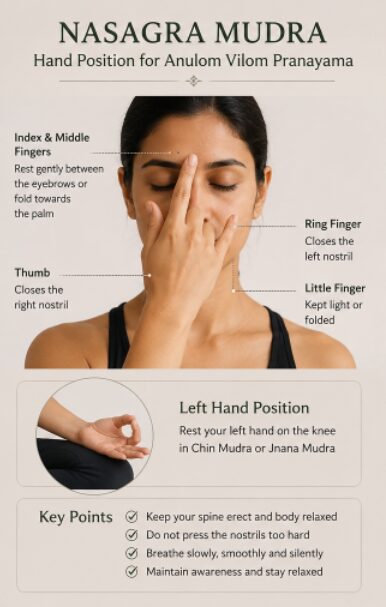
Traditionally, Anulom Vilom is practiced using Nasagra Mudra, which allows you to alternate the flow of breath between the nostrils.
- Use your right thumb to gently close the right nostril.
- Use your ring finger (and little finger if needed) to close the left nostril.
- The index and middle fingers may either rest lightly between the eyebrows or be folded comfortably toward the palm.
- Rest your left hand on your knee in Chin Mudra or Jnana Mudra.
Avoid pressing the nostrils too firmly. A gentle touch is enough to regulate the airflow
Stage 1: Establishing the Breath (Beginner)
If you are new to pranayama, your goal is not to control the breath but simply to become familiar with its natural rhythm.
Step-by-Step Practice
- Close the right nostril with your thumb.
- Inhale slowly through the left nostril.
- Close the left nostril with your ring finger.
- Release the thumb and exhale through the right nostril.
- Inhale through the right nostril.
- Close the right nostril.
- Exhale through the left nostril.
This completes one round of Anulom Vilom.
Continue breathing in this pattern for 5–10 minutes, allowing each breath to be smooth, slow, and silent. There is no need to count the breath or hold it at this stage.
Instead, focus on:
- Breathing effortlessly.
- Keeping the breath quiet and even.
- Remaining relaxed throughout the practice.
The aim during this stage is simply to develop awareness and consistency.
Practice this for few days or weeks and move to the next stage.
Stage 2: Cultivating Rhythm (Intermediate)
Once the basic technique feels natural and the breath flows comfortably without strain, you may gradually introduce gentle counting. This helps develop better breath control and encourages a deeper sense of calm.
Begin by maintaining an equal breathing ratio:
Inhale – 4 counts
Exhale – 4 counts
After a few weeks of regular practice, if this feels comfortable, you can slowly lengthen the exhalation:
Inhale – 4 counts
Exhale – 8 counts
A longer exhalation naturally encourages the body to relax and is often experienced as deeply calming. Never force the breath to fit the count. If you feel any discomfort, simply return to a natural rhythm.
Practice for 10–20 minutes, maintaining a smooth and uninterrupted flow of breath.
Stage 3: Deepening the Practice (Advanced)
As your breathing becomes steady and effortless over several months of consistent practice, you may choose to explore the traditional practice of Nadi Shodhana under the guidance of an experienced yoga teacher.
At this stage, Kumbhaka (breath retention) is gradually introduced.
One of the classical breathing ratios described in yogic texts is:
- Inhale – 4 counts
- Hold – 16 counts
- Exhale – 8 counts
The purpose of breath retention is not to test your capacity but to deepen the purification of the nadis and cultivate greater control over the movement of prana. This practice should always remain comfortable and should never involve straining or forcing the breath.
Advanced practitioners may also synchronize the breath with:
- Mantra repetition
- Chakra awareness
- Meditation
- Subtle observation of pranic flow
These practices belong to the deeper stages of yoga and are best learned through proper guidance.
How Long Should You Practice?
The duration of your practice depends on your level of experience.
| Level | Recommended Duration |
| Beginner | 5–10 minutes |
| Intermediate | 10–20 minutes |
| Advanced | 20–30 minutes |
Remember, consistency is more important than duration. A daily practice of ten minutes is generally more beneficial than practicing once a week for an hour.
Best Time to Practice
Traditionally, the most beneficial time to practice Anulom Vilom is early in the morning, preferably during Brahma Muhurta or shortly after sunrise, when the mind is naturally calm and the atmosphere is fresh. Practicing on an empty stomach at this time helps the breath flow more freely and prepares the mind for meditation.
If mornings are not possible, the evening is also an excellent time, provided you have not eaten for at least two to three hours. Many practitioners also find it helpful to practice before meditation, as it naturally settles the mind and improves concentration.
A gentle session before bedtime can also help release the stress accumulated during the day and promote restful sleep. However, avoid advanced practices involving breath retention late at night.
Common Mistakes to Avoid
Even though Anulom Vilom is simple, a few common mistakes can reduce its effectiveness.
- Forcing the breath instead of allowing it to flow naturally.
- Raising the shoulders while inhaling.
- Pressing the nostrils too firmly.
- Breathing too quickly or making unnecessary sound.
- Holding the breath before mastering the basic technique.
- Practicing immediately after a heavy meal.
- Becoming overly focused on counting instead of maintaining a relaxed breath.
Remember, pranayama is not about how long you can hold your breath but about how effortlessly you can breathe.
Precautions
Anulom Vilom is generally safe for most healthy individuals, but a few precautions are worth keeping in mind.
- Practice gently if you have a cold, severe nasal congestion, or sinus infection.
- Avoid breath retention if you have uncontrolled high blood pressure, heart disease, or are pregnant, unless guided by a qualified teacher and healthcare professional.
- Stop the practice if you experience dizziness, discomfort, or shortness of breath, and return to normal breathing.
- Never force the breath or continue through pain or strain.
When practiced with awareness and patience, Anulom Vilom remains one of the safest and most accessible pranayama techniques.