Understanding the Power of Self-Healing
“The body has an extraordinary ability to heal itself. Sometimes all it needs is the right environment, the right intention, and our conscious attention.”
Every human being has experienced self-healing, whether they realize it or not. A cut on your finger closes without you consciously instructing your cells. A broken bone gradually mends itself. Your immune system constantly fights viruses and repairs damaged tissues. Every second, millions of cells die and millions of new cells are created.
Healing is not something we invent—it is something our body is already doing.
The real question is: Can we consciously support this natural healing process?
Let’s explore what self-healing truly means and how focused awareness may become one of the most powerful healing tools available to us in this process.
What Is Self-Healing?
Self-healing is the body’s natural capacity to restore balance after illness, injury, emotional trauma, or stress.
Healing happens on multiple levels:
- Physical
- Mental
- Emotional
- Energetic (according to many spiritual traditions)
- Social
- Lifestyle
While medicine treats disease externally, self-healing focuses on activating the body’s own internal repair mechanisms. This does not mean replacing medical care. Instead, self-healing works best as a complementary approach alongside appropriate medical treatment whenever needed.
Why Do Humans Have the Ability to Heal?
Our body is continuously working to maintain equilibrium. Scientists call this homeostasis. Every day our body:
- Repairs tissues
- Produces new cells
- Balances hormones
- Removes damaged proteins
- Creates immune responses
- Maintains body temperature
- Repairs DNA damage
Even while we sleep, our body is remarkably active in repair and restoration. Healing is our body’s default state. The challenge is that modern lifestyles often interfere with this process through chronic stress, poor sleep, unhealthy diet, emotional suppression, and constant mental stimulation.
Different Techniques of Self-Healing
There is no single standard method for this. Different techniques work by supporting different aspects of the healing process.
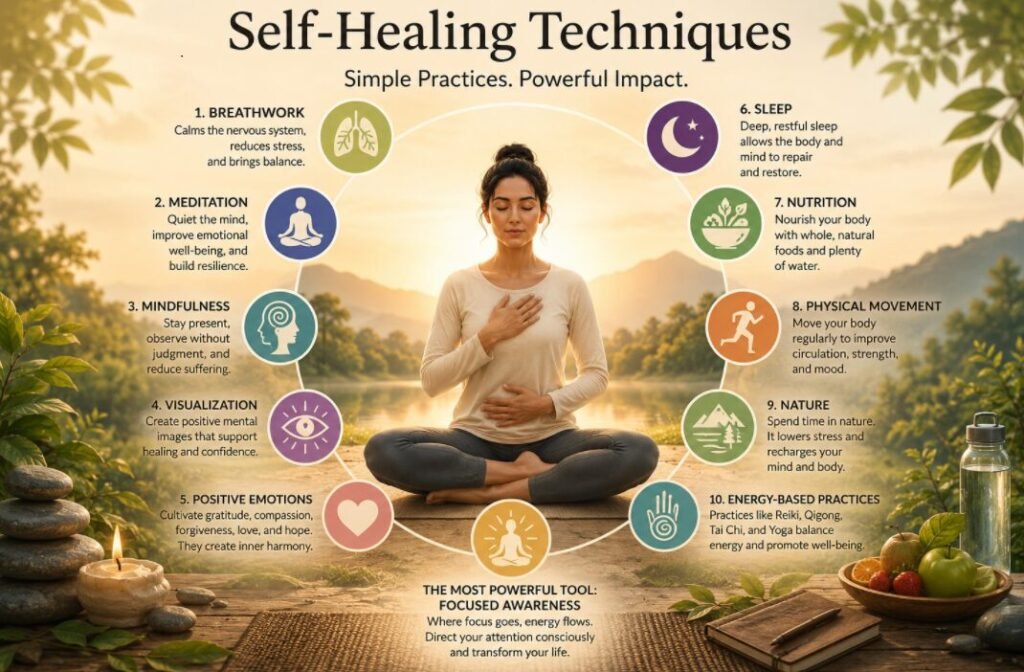
1. Breathwork
The breath is one of the simplest ways to influence the state of the body and mind. Unlike many other bodily processes, breathing happens automatically, yet we can also consciously change its rhythm, depth, and pace. This makes the breath a bridge between the conscious mind and the nervous system.
When we are stressed, anxious, or emotionally overwhelmed, breathing often becomes faster, shallower, or irregular. Conversely, slow and comfortable breathing can send signals of safety to the nervous system and encourage the body to move away from a prolonged state of tension.
Regular, mindful breathing practices may help to:
- Reduce the physiological effects of stress
- Support healthier blood pressure and heart-rate regulation
- Improve breathing efficiency and oxygen exchange
- Quiet mental agitation and improve emotional regulation
- Encourage parasympathetic, or “rest and digest,” activity
- Create a greater sense of calm, presence, and inner stability
From a self-healing perspective, breathwork is not about forcing the body to heal. It is about creating conditions in which the body’s natural processes of regulation and recovery can function more effectively.
Sometimes healing begins with something as simple as learning to breathe in a way that tells the body: you are safe enough to relax.
2. Meditation
Meditation is not simply about stopping thoughts. At a deeper level, it is the practice of developing a different relationship with the mind.
When we constantly react to thoughts, worries, memories, and fears, the nervous system can remain in a state of subtle tension. Meditation creates a space in which thoughts can be observed without immediately being followed or resisted.
With regular practice, meditation may help to:
- Reduce the effects of chronic stress
- Improve emotional regulation
- Support better sleep
- Reduce anxiety and mental restlessness
- Improve attention and self-awareness
- Develop greater resilience during difficult situations
As the mind gradually becomes less reactive, the body can also move toward a more regulated state. In this sense, meditation supports self-healing not by forcing a particular outcome, but by creating greater inner balance and reducing the mental and physiological burden of prolonged stress. When the mind learns to become still, the body is often given more space to restore itself.
3. Mindfulness
Mindfulness is the practice of bringing full attention to the present moment without immediately judging, resisting, or trying to change what is being experienced.
This becomes particularly valuable when dealing with pain, discomfort, difficult emotions, or uncertainty. Our experience of suffering is often influenced not only by what is happening in the body, but also by the thoughts and fear surrounding it.
Mindfulness creates a small but important distance between experiencing something and reacting to it. Instead of thinking, “Why is this happening to me?” or “This must get better immediately,” we learn to observe sensations, emotions, and thoughts with curiosity.
This can help:
- Reduce unnecessary mental resistance
- Improve awareness of bodily signals
- Develop emotional balance
- Prevent difficult emotions from becoming overwhelming
- Create a greater sense of acceptance and presence
Mindfulness does not mean ignoring pain or accepting harmful conditions without action. It means learning to meet the present experience with greater clarity rather than adding layers of fear and resistance to it.
Sometimes healing begins when we stop fighting the experience long enough to understand it.
4. Visualization
The mind responds not only to what is physically happening, but also to what we imagine, anticipate, and repeatedly focus upon. This is one reason visualization has been used for decades in areas such as sports, performance, rehabilitation, and mental training.
In a healing context, some people use visualization to create a positive internal image of recovery. They may imagine something like:
- A feeling of warmth or healing light moving through the body
- The body becoming stronger and healthier
- Healthy tissues replacing damaged ones
- An area of discomfort gradually relaxing
- The immune system and body’s natural processes functioning effectively
It is important to distinguish between using visualization as a supportive practice and claiming that imagination can directly repair disease or damaged tissue. Evidence for visualization directly healing physical conditions remains limited.
However, visualization may help reduce stress, improve confidence, encourage relaxation, and strengthen motivation to follow healthy behaviors. For some people, it also provides a meaningful way to connect the mind with an intention for healing.
Visualization may not replace physical healing processes, but it can help create a mental environment that supports them.
5. Positive Emotional States
Our emotional state is not separate from the body. Emotions influence breathing, heart rate, muscle tension, hormones, attention, sleep, and the way we respond to stress.
States such as gratitude, compassion, forgiveness, love, and hope can create a sense of safety, connection, and meaning. They may help counterbalance the effects of prolonged psychological stress and support emotional resilience.
Practices that cultivate positive emotional states can include:
- Gratitude and appreciation
- Compassion toward ourselves and others
- Forgiveness and letting go of persistent resentment
- Loving relationships and meaningful connection
- Hope and a sense of purpose
This does not mean that negative emotions are unhealthy or should be suppressed. Anger, sadness, fear, and grief are natural parts of being human and often carry important information. The concern is not having negative emotions, but becoming chronically trapped in stress, resentment, fear, or emotional suppression without opportunities for processing and recovery.
Self-healing therefore does not require constant positivity. It requires developing the capacity to feel emotions, process them, and gradually return to balance.
6. Sleep
Sleep is perhaps one of the most underestimated forms of healing. While we may think of sleep as simply a period of rest, the body is actively carrying out important maintenance and recovery processes during this time.
Adequate, good-quality sleep is very important for :
- Tissue growth and repair
- Immune system function
- Hormonal regulation
- Memory and learning
- Emotional processing
- Metabolic health
- Recovery from physical and mental stress
During deeper stages of sleep, processes involved in physical restoration become particularly active. Sleep also gives the nervous system an opportunity to move away from the constant stimulation of waking life.
This is why repeatedly sacrificing sleep for work, entertainment, or other activities can eventually affect both physical and emotional well-being.
Healing does not always require doing more. Sometimes the most supportive thing we can do is stop, rest, and allow the body to do the work it already knows how to do.
7. Nutrition
Food is more than a source of energy. The nutrients we obtain from food become part of the raw materials the body uses to build, maintain, and repair itself.
A balanced diet provides the body with essential components such as:
- Protein for tissue maintenance and repair
- Healthy fats for cell membranes, hormones, and brain function
- Vitamins and minerals for numerous metabolic processes
- Fiber for digestive and metabolic health
- Water required for almost every function of the body
- Plant compounds that can support overall health
Self-healing does not require a perfect diet or constantly searching for “superfoods.” What matters more is consistently providing the body with adequate nutrition and avoiding prolonged deficiencies or excessive reliance on highly processed foods.
Food cannot replace necessary medical treatment, but good nutrition can provide the building blocks and supportive environment that allow the body’s normal repair processes to function properly.
8. Physical Movement
The human body is designed to move. Regular movement supports many of the systems involved in maintaining physical and emotional health.
It does not necessarily have to mean intense exercise. Depending on a person’s health and physical capacity, walking, stretching, yoga, gentle mobility exercises, or simply changing positions regularly can all be valuable.
Movement also reminds the body that it is capable of functioning, adapting, and becoming stronger.
At the same time, healing requires balance. Excessive exercise without adequate recovery can place additional stress on the body.
The goal is not to push the body harder, but to give it the kind of movement it needs to remain alive, adaptable, and resilient.
9. Nature
Modern life often keeps us surrounded by artificial environments, screens, noise, and constant stimulation. Spending time in natural surroundings can provide a very different sensory experience.
Natural light, greenery, fresh air, open spaces, natural sounds, and even simply walking outdoors can help create a calmer mental state. Research suggests that spending time in nature may reduce perceived stress and support mood and psychological well-being.
Nature can also encourage other healing behaviors naturally: walking, breathing fresh air, receiving daylight, slowing down, and temporarily disconnecting from digital stimulation.
From a spiritual perspective, nature can offer something beyond these measurable effects. It can remind us that healing is not always about controlling life, but about reconnecting with the rhythms of life.
Sometimes stepping away from the noise of life allows the body and mind to remember how to become quiet.
10. Energy-Based Practices
Many traditional systems understand health not only in terms of the physical body, but also through subtle forms of energy or life force. Different traditions use different concepts and terminology, such as prana, qi, or subtle energy.
Practices associated with these traditions include:
- Reiki
- Qigong
- Tai Chi
- Pranic Healing
- Yogic practices
- Various forms of energy meditation
Some of these practices involve movement and breath, while others emphasize meditation, intention, touch, or the practitioner’s perception of subtle energy.
Scientific research does not currently establish a clear physical mechanism for many of the claims traditionally made about subtle energy or energy transfer. However, people may experience relaxation, reduced stress, greater body awareness, emotional comfort, or a sense of connection through these practices.
They can therefore be approached as complementary practices for well-being, rather than as replacements for appropriate medical diagnosis or treatment.
From a spiritual perspective, however, their significance may extend beyond what can currently be measured. They invite us to explore the possibility that our experience of health involves dimensions of awareness and interconnectedness that are not yet fully understood.
Whether understood spiritually, psychologically, or through the language of subtle energy, these practices can encourage a deeper relationship with the body and the experience of being alive.
The Most Powerful Tool: Focused Awareness
“Where focus goes, energy flows.” But what does this actually mean?
Imagine shining a flashlight in a dark room. Wherever you point it, that area becomes clearer while everything else fades into the background.
Our attention works in a similar way. At any given moment, countless sensations, thoughts, emotions, and signals are present within and around us, but the brain cannot process all of them with equal intensity. It continually decides what deserves our attention.
What we repeatedly focus on therefore begins to shape our experience.
If we constantly focus on fear, pain, problems, and everything that could go wrong, the mind can reinforce those patterns and keep the body in a state of heightened alertness. If we consciously bring attention toward the breath, bodily relaxation, gratitude, safety, or constructive action, we can begin to create a different internal response.
This does not mean that simply thinking positively can eliminate illness or that attention can magically control every biological process. Rather, attention influences the mental and physiological environment in which we experience life.
This is why awareness is so important in self-healing. Before we can change a pattern, we first need to notice it. Before we can relax the body, we need to recognize where we are holding tension. Before we can change a thought pattern, we need to become aware of the thoughts running through the mind.
In this sense, focused awareness is not about forcing the body to heal. It is about learning where our attention is going and consciously choosing where we want to place it.
Attention is one of the most valuable resources we possess. What we repeatedly give our attention to can gradually shape our inner experience—and, through that, the way we live, respond, and care for ourselves.
A Simple Self-Healing Practice
Find a quiet place. Close your eyes. Take slow breaths.
Relax your shoulders. Now bring your full awareness to the affected area.
If your knee hurts… Focus only on the knee.
If your stomach is uncomfortable… Rest your attention there.
Do not analyze. Do not judge. Simply observe.
Now imagine every inhale bringing nourishment. Every exhale releasing tension.
Picture warmth spreading through the area.
Imagine every cell receiving exactly what it needs.
Stay there for 10–20 minutes.
You may notice – Warmth, Tingling, Pulsation, Relaxation, Emotional release or simply a sense of calm
Not everyone will experience noticeable sensations, and that’s perfectly okay. The value of the practice lies in gentle, sustained attention rather than chasing specific experiences.
Healing Is a Daily Practice
Self-healing is not a miracle that happens overnight.
It is a relationship with yourself. Every healthy meal. Every mindful breath. Every good night’s sleep.
Every act of self-compassion. Every moment of conscious awareness.
Each one contributes to creating the internal conditions in which healing can flourish.
Final Thoughts
“Where focus goes, energy flows.”
Whether you interpret “energy” as the body’s biological resources, the mind’s attention, or a deeper life force described in spiritual traditions, the message remains meaningful:
Your attention shapes your experience.
When you consciously direct that attention with patience, calmness, and compassion, you create space for your body’s remarkable healing intelligence to do what it has always been designed to do.
Self-healing is not about forcing the body to recover or denying the need for medical care. It is about partnering with your body’s natural wisdom—supporting it through awareness, healthy habits, and hope.